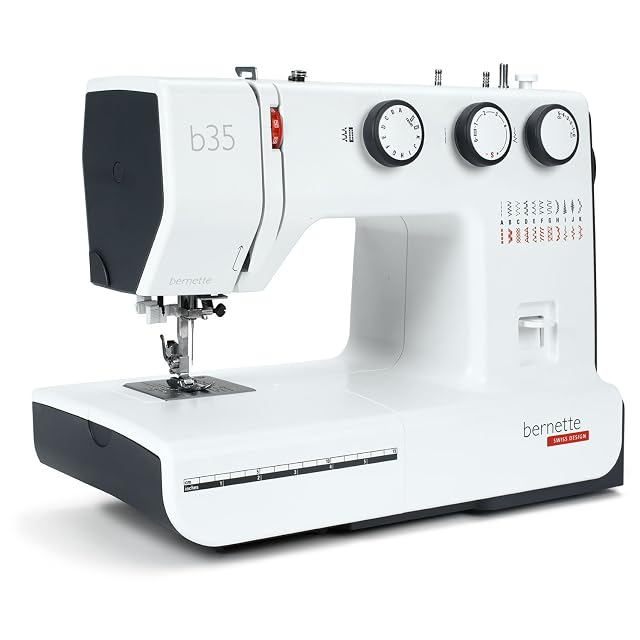
bernette b35
Bernina-group entry machine
The entry bernette, present on five markets — under one reference across continental Europe and a separate British one.
Best for: A first machine from the Bernina group without Bernina money
≈ £240 / 300 €
Dial-operated machines · review
The larger Tradition, listed with 32 stitches, a one-step buttonhole and an automatic needle threader, across five European markets.
The bottom line The buttonhole and the threader are what separate this from the plainest Traditions.
Hands-on testing pending. Everything below is either a manufacturer specification, cited as such, or something we verified ourselves.
What we verified. The reference B07NCKDSNT designates this machine on
amazon.de, .fr, .it, .es and .co.uk, confirmed on the barcode. It is absent from
amazon.com under this reference.
What Singer states. Thirty-two stitches, a one-step buttonhole and a one-motion automatic needle threader. All three come from the Spanish listing — the German, French, Italian and British pages are titled with the model number and almost nothing else, which is why we name the source. The barcode is the same on all five, so the machine is the same machine; only the description differs.
Where it sits in the range. The Tradition line runs from very plain machines up to this one, and the difference between them is largely the buttonhole method and the threader. If you sew garments, buttonholes will come up, and the one-step mechanism is the feature most worth paying the step up for. If you sew curtains and cushions, it is money you will not use.
Where we would look before buying. The machine’s weight, which none of the five listings publish and which is the best single proxy for how much metal is inside it.
| Type | Mechanical |
|---|---|
| Stitches | 32 (manufacturer) |
| Buttonhole | One-step (manufacturer) |
| Needle threader | Automatic (manufacturer) |
| Amazon reference | B07NCKDSNT (five European markets) |
A one-step buttonhole is sewn in a single continuous operation: you set the button in the foot, press the pedal, and the machine sizes and stitches all four sides itself. A four-step buttonhole makes you turn a dial between each side and judge the length by eye. The one-step version produces buttonholes that match each other down a shirt front, which the four-step version does not reliably do.
More than it sounds. It is a small hook that pushes the thread through the eye for you. Most people dismiss it until they have threaded a needle forty times in an afternoon, or until their eyesight changes. It is one of the few convenience features on a cheap machine that earns its place.
Bernina-group entry machine
The entry bernette, present on five markets — under one reference across continental Europe and a separate British one.
Best for: A first machine from the Bernina group without Bernina money
≈ £240 / 300 €
Mechanical · portable · Bernina network
Bernette's portable mechanical machine, and one of only three products on this site available under a single reference on all six Amazon stores.
Best for: Dressmaking and everyday sewing where stitch quality matters more than power
≈ $350 / 400 €
Mechanical · 25 stitches
Janome's mechanical mid-range machine — and the second Janome in our checks that is absent from the French, Italian and Spanish Amazon catalogues.
Best for: US and UK readers who want a Janome mechanical at mid-range money
≈ $400 / £390